
 English
 中文简体
中文简体 русский
Walking your dog ought to feel relaxed and easy instead of turning into a workout for your hands and arms. The Opey Dog Leash and other current retractable styles show real progress in pet gear, tackling issues that Modern Pet Dog Leash with Soft TPR Handle never really fixed. These Leashes blend smart engineering with better materials to match the way dogs actually act on walks, not just how we imagine they should. Getting what makes them stand out means going past the obvious extras to look closely at the materials, the way the mechanism works, and the everyday details that change how the walk feels. Anyone who's walked an excited dog for a long stretch knows how quickly your hands and wrists start to ache. The steady grip you hold, the sharp tugs you brace against, and all the little corrections add up to real strain. Newer retractable Leashes tackle this through careful choices, especially in how the handle is built and how the inside parts move. What really separates today's versions is the use of soft thermoplastic rubber in the grip area that completely changes how the Leash feels in your hand. That material, paired with smoother internal systems, delivers a much more comfortable walk than older models that focused more on keeping costs low than on making the experience pleasant.
Understanding the Construction: What Makes a Retractable Leash Work
A retractable Dog Leash brings together several key parts that cooperate to give both control and flexibility:
- Housing unit: The tough plastic or composite body that holds the spring and cord spool inside, shaped so it sits naturally in your hand
- Retraction system: A coiled spring tucked inside that keeps steady pull on the cord and reels it back in whenever your dog steps closer
- Cord or tape: The part that stretches out—either a thin round cord like a strong string or a wider flat tape similar to sturdy webbing—each feeling and handling a bit differently
- Brake mechanism: Usually a thumb button or sliding lever you press to halt the cord from paying out any further when you need to stop extension
- Lock function: A setting that keeps the brake fully on so the length stays fixed until you release it
- Handle grip: The area your hand wraps around, now often covered in soft thermoplastic rubber for better hold
- Swivel clip: The metal piece that spins freely where it attaches to the collar or harness, stopping the cord from twisting up as your dog turns
- Traffic handle (on some models): An extra loop placed closer to the clip that lets you grab for quick, short control
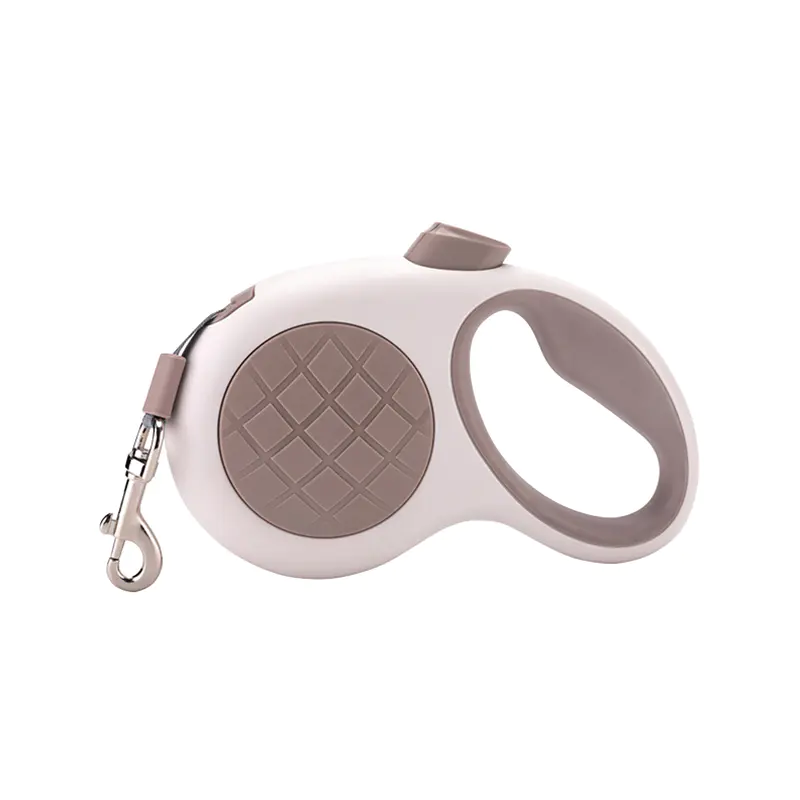
The thermoplastic rubber covering modern handles stands out for good reason. It feels noticeably different from the neoprene, foam padding, or cloth wraps you used to see on older Leashes. TPR gives a slightly sticky texture that helps your hand stay put without digging in painfully. Unlike foam that flattens out over time or fabric that soaks up sweat and grime, TPR keeps its shape and wipes clean with almost no effort. It also softens the jolt a little when your dog lunges, so less of the shock reaches your wrist and hand.
Dog Leash lengths differ quite a bit between models, usually falling between twelve and twenty-six feet. Shorter ones give you faster, tighter control, while longer versions let your dog roam farther when the setting allows it. Choosing between cord and tape comes down to small trade-offs: round cord often feels stronger for its size and stays less noticeable, whereas flat tape spreads out more, can be easier to see, and usually hurts less if you have to grab it suddenly.
Clip quality makes a real difference too. Cheaper zinc alloy clasps hold up fine at first and keep costs down, but they can start to rust or weaken after getting wet repeatedly. Stainless steel clips resist rust far better and handle stronger pulls, although they make the whole Leash a little heavier and more expensive. The built-in swivel in the clip lets it rotate smoothly so the cord doesn't kink or twist when your dog spins around or changes direction, which helps everything last longer.
Safety Concerns and Risk Reduction Strategies
Retractable Leashes rely on a careful balance—the internal spring always tries to pull the cord back in, while your dog's movement and the brake you control decide how far it goes. The setup works smoothly most of the time, but it brings some specific hazards that ordinary fixed Leashes simply don't have.
Common failure modes include:
- Cord fraying near the exit point or clip attachment, often invisible until failure occurs
- Brake mechanism wear causing delayed response or incomplete stops
- Housing cracks from impacts or excessive force during pulls
- Spring fatigue reducing retraction reliability
- Clip failure under stress, particularly with lower-grade hardware
Some situations make these problems much worse. Busy sidewalks or paths turn long cords into trip wires when they cross in front of people. Dogs that react strongly to other animals or strangers can yank hard and fast, putting sudden heavy strain on every part at once. Because the Leash lets your dog get farther away before hitting the end, they can pick up real speed and slam into the limit with more force than a short fixed Leash would ever allow.
Reducing those risks takes consistent habits:
Get comfortable using the brake so your thumb naturally rests right on the button, ready to press the instant you need to stop extension. Save the lock setting for times when you want a steady, unchanging length—like walking next to traffic or moving through tight crowds—so the cord can't creep out if your finger slips off the brake.
When a model has a traffic handle, use it for moments that demand instant close control: stepping off a curb, squeezing past someone, or handling a sudden meeting with another dog. Dropping your hand to that loop pulls your dog right back to your side in one quick motion.
Weight and strength matching requires attention:
| Dog Weight | Minimum Cord Strength | Recommended Leash Type |
|---|---|---|
| Under 15 pounds | 60 lb tensile | Small / lightweight cord |
| 15–40 pounds | 90 lb tensile | Medium cord or tape |
| 40–80 pounds | 150 lb tensile | Heavy-duty tape |
| Over 80 pounds | 200+ lb tensile | Extra-strong tape or consider fixed leash |
Check the Leash carefully before every walk. Run your fingers along the cord looking for any frayed spots, worn areas, or splits. Press the brake and lock a few times to make sure they catch firmly and release cleanly. Tug lightly on the clip to confirm the swivel spins freely and the gate closes securely. Look over the housing for any cracks or parts that feel loose. If anything looks questionable or worn, replace the whole Leash—trying to patch or fix critical safety gear isn't worth the risk.
How your dog behaves matters just as much as the equipment itself. Dogs still learning Leash skills can actually pick up bad habits faster on retractables because the changing length sends mixed signals about boundaries. If your dog charges to the end and keeps pulling, the extra freedom ends up reinforcing that behavior. Teaching solid basics like "come close" or "easy" first makes switching to a retractable Leash much smoother and safer for everyone.
Why Soft TPR Handles Reduce Fatigue and Improve Grip
Old-school hard plastic handles press sharply into your palm and fingers at specific spots, building up soreness pretty quickly even on a half-hour walk. As time goes on, those same pressure points turn uncomfortable and can lead to blisters or rough skin if you walk often. The soft thermoplastic rubber layer added to newer handles spreads that contact over a much wider area so no single spot takes all the force, cutting down on those painful hotspots right from the start.
The way TPR behaves under load helps even more. It has a bit of flex that lets it mold slightly to the shape of your hand without squashing flat, giving a more natural, secure feel that fits without any fancy adjustments. When your dog yanks unexpectedly, the material gives just enough to stretch out the sudden force over a longer moment, so the peak jolt hitting your hand and wrist feels noticeably lighter—even though it's not a full shock-absorbing setup, the difference shows up clearly on walks with lots of stops and starts.
Shape plays a big role too beyond just the material. A handle that keeps your wrist in a straight, neutral line instead of bent sharply up or down takes strain off the muscles and tendons running through your forearm. Where the brake button sits matters for easy use—ideally it lands right under your thumb so you don't have to shift your whole grip every time you need to stop the cord.
Different people notice these advantages in their own ways:
- Smaller hands benefit from more compact housing dimensions and handles that don't force finger overextension
- Arthritis sufferers find softer materials reduce joint stress, though very weak grip strength may struggle with brake control
- Runners often prefer handles designed for forward-facing grip rather than downward hanging orientation
- Extended walks reveal comfort differences that short trips mask
Trying the handle out before buying gives you the best sense of it. Grab the Leash in your usual hand, hold it for a few minutes, and mimic your normal walking swing. Pretend to brake against a pull a few times. Pay attention to any pinching spots, odd wrist angles, or buttons that feel hard to reach. Those little tests usually match up well with how it actually feels out on a real walk.
Selecting Equipment That Matches Your Situation
Picking the right Leash means looking at several things together instead of zeroing in on just one detail or shiny feature. Your dog's size and habits set the starting point, but where you walk and what you do there change what actually works best.
Decision framework:
Begin with how big your dog is and how much they tend to pull. A relaxed small dog puts very different stress on a Leash compared to a bigger one that lunges when excited. The actual force they generate often matters more than their weight—some little dogs can yank surprisingly hard. Next think about your usual walking spots. City streets full of cars, people, and other dogs call for quick, close control and shorter max lengths. Open parks or quiet trails where you can see far ahead and meet fewer surprises let longer reaches feel safe and fun.
What you're doing on the walk narrows it down further. A laid-back neighborhood loop isn't the same as focused training time or going for a jog. Training usually pairs better with fixed Leashes because steady length helps dogs understand clear rules. The changing reach on retractables can make it harder for them to learn what's expected. Running or fast-paced walks often need hands-free options or short fixed Leashes since managing a retracting cord gets in the way of keeping a steady rhythm.
Feature checklist for comparison:
- Length options and whether the mechanism allows partial locking at intermediate distances
- Cord versus tape material and diameter/width specifications
- Reflective trim or cord for visibility during low-light conditions
- Dual handle configuration (primary plus traffic handle)
- Locking mechanism strength and ease of engagement
- Clasp type, material, and swivel quality
- Warranty coverage and duration
Retractable Leashes fitted with TPR handles suit dogs that already know how to walk nicely on Leash and spend time in places where a bit more freedom makes the outing better without adding real danger. They don't fit as well for active training, dogs that react strongly to things around them, or any walk where you need to stay right beside your dog the whole time. In those cases, a regular fixed-length Leash—especially one with cushioned grips—usually gives clearer control and more consistent boundaries.
Proper Usage Techniques That Prevent Problems
Good habits start at home before you even step out the door. A quick pre-walk check catches trouble early and keeps things safe:
- Pull the cord all the way out and look over every inch for any fraying, nicks, or thin areas
- Let it retract on its own and watch how fast and smooth it comes back in—any sticking or slow spots mean something's off inside
- Press and let go of the brake button a few times to make sure it grabs hard and releases cleanly every time
- Flip the lock on and tug to confirm it holds steady without slipping
- Look at the clip closely for any bends or cracks, then spin it to check that it moves freely
- Give the housing a once-over to spot any splits, loose bits, or signs it's coming apart
This whole check takes under a minute but stops most equipment surprises before they happen.
How you hold the Leash makes a big difference in staying in control:
Wrap your fingers around the handle with your dominant hand so it feels natural and secure. Let your thumb sit right on the brake button without twisting your wrist or shifting your grip. The cord should come out from the bottom of the housing and hang straight down. Never wrap the cord around your fingers or palm—even a quick pull can tighten it like a tourniquet and cause cuts or worse.
Use the brake as your main way to guide your dog while walking. Give it a short press to ask them to ease up or pause, then let go once they settle so they get the freedom back as a reward. Switch to the lock when you need a set length that won't change—like nearing a busy road, walking through a crowd, or anywhere you want steady distance. Get in the habit of unlocking it again when the situation opens up; forgetting this step is common and leaves people puzzled why the Leash suddenly won't give more line.
Keep an eye on how much cord is out at any moment. Letting your dog hit full extension in every direction builds up loose slack when they turn back toward you. That extra line tangles easily, snags on things, and slows down how fast you can react. Aim for a medium reach that gives your dog room to explore but still lets you hit the brake before they get too close to trouble.
Training exercises that improve retractable Leash manners:
- Practice recall commands while your dog stands at various distances, rewarding return behavior
- Teach a "stop" or "wait" cue that means halt and look back at you
- Work on attention checks where your dog periodically looks to you for direction
- Establish boundaries for appropriate pulling force, using brake engagement to interrupt excessive pulling
When things go wrong, stay calm and act quickly. If your dog darts off, hit the brake right away and brace your stance for the jolt. If the brake sticks and the cord keeps paying out, step firmly on the line with your foot instead of grabbing it—bare hands get rope burns fast from the sliding cord. For cords wrapped around poles, people, or other obstacles, talk soothingly to your dog while you backtrack along the line to find and untangle the snag. Should a part break mid-walk, grab the traffic handle if your model has one to keep your dog close, or carefully coil the cord by hand while holding tight to the housing.
Maintenance Practices That Extend Equipment Life
TPR handles clean up easily but do best with gentle care. Wipe them down using a damp cloth and a little mild dish soap, then rinse off any soap residue with plain water. Skip harsh solvents, heavy-duty cleaners, or rough scrubbers that can rough up or break down the surface. The grippy feel that helps you hold on comes from the TPR itself—strong chemicals can wear that quality away over time.
Cords and tapes need slightly different attention depending on what they're made of and what they've been through. After rainy or muddy walks, pull the full length out and let it air dry completely before you let it rewind. Water left inside can rust metal pieces or grow mold on fabric tape. Wipe off dirt, grit, or sand from the extended line with a lightly damp cloth, especially around the spot where it comes out of the housing since that area collects the most buildup.
The swivel in good clips stays smoother longer with a touch of light machine oil now and then—just one small drop on the pivot point, then wipe off anything extra so it doesn't attract dust. When the clip starts showing wear or the spring feels weak, some better-made Leashes let you buy replacement parts, but often it's simpler and safer to get a whole new Leash.
Where you keep the Leash between walks matters a lot. Don't leave it sitting in a hot or freezing car since big temperature swings speed up wear on the plastic and TPR. Sunlight coming through windows fades and weakens both the housing and cord over time. Try to store it indoors in a spot that stays roughly room temperature. Hanging it up so the housing hangs free instead of sitting pressed against something helps avoid flat spots or warping from constant pressure.
Troubleshooting Common Mechanical Issues
Slow or uneven retraction usually comes from a tired internal spring or the cord catching somewhere inside. When it starts dragging, pull it all the way out and check the exit area for rough edges or damage. Dirt packed into the mechanism can slow things down too—sometimes taking the housing apart for a clean fixes it, but that often voids any warranty and needs careful putting back together.
A brake that feels spongy, slow, or doesn't catch fully is a serious red flag. That kind of wear means the Dog Leash isn't safe anymore. Don't try to fix it yourself—just replace the whole thing right away. While normal use wears parts gradually, brakes can suddenly get much worse without much warning.
Fraying shows up most often right where the cord leaves the housing or attaches to the clip—those spots take the most rubbing and pulling. Checking regularly spots small damage before it turns into a snap. Once you see broken strands or serious wear in the load-bearing parts, swap the Dog Leash out immediately. There's almost no safety buffer left once visible damage starts.
Clip trouble usually means the spring in the gate is getting weak or the swivel has seized up. A clip that doesn't latch firmly or opens too easily risks losing your dog. Swivel issues let twists build up in the cord and shorten its life, though they don't usually cause sudden failure.
Safety rule for all problems: When in doubt about any component's condition, replace the Pet Leash. The modest cost of new equipment carries far less weight than the consequences of failure during use.
Comparing Alternative Leash Designs
Fixed-length Leashes with padded handles put control and training first instead of giving your dog lots of room to roam. That steady six-foot reach sets firm, easy-to-understand limits that help dogs figure out what's expected. The cushioned grips cut down on hand tiredness in much the same way the soft TPR does on retractables. These work especially well when you're working on obedience, handling a dog that reacts to things, or walking in busy places where staying close is a must.
Hands-free Leashes that buckle around your waist fit runners, hikers, or anyone who wants both hands open for other things. They take hand strain completely out of the picture but make it harder to adjust length or react quickly. They suit calm, reliable dogs with solid recall, though they can turn tricky with animals that pull without warning.
Rope Leashes stand up to heavy use and feel straightforward in the hand, but you have to watch your grip carefully to avoid rope burns if your dog lunges hard. Leather versions bring a timeless look and hold up for years with regular care, although they need occasional conditioning and proper drying after getting wet. Neither rope nor leather really pairs well with retractable systems.
Comparison summary:
| Feature | Retractable TPR | Fixed Padded | Rope | Hands-Free |
|---|---|---|---|---|
| Freedom of movement | High | Low | Low | Medium |
| Control precision | Medium | High | High | Low |
| Training suitability | Low | High | High | Low |
| Hand comfort | High | High | Medium | N/A |
| Durability | Medium | High | Very High | Medium |
| Price range | Medium | Low–Medium | Low | Medium |
Walking more than one dog at a time usually rules out retractables—trying to juggle several brake buttons while keeping lines from tangling gets chaotic fast. Fixed-length Leashes with padded handles, maybe hooked to a double coupler worn at the waist, handle the job more safely and smoothly.
Balancing Competing Priorities
Picking the right Pet Leash means trading off comfort for control, freedom for safety, and toughness for cost—no one type wins in every case. Retractable Leashes with soft TPR handles fill a particular role: they bring real comfort and let your dog range out when they've learned polite walking habits and when you're in spots where extra space makes walks better without adding real risks.
In the right setup, you feel the advantages clearly: much less hand and wrist ache on longer outings, the option to let your dog sniff around while still having fast brake access, and thoughtful design touches that make holding it easier overall. But when your needs shift—whether it's focused training, a dog that gets worked up easily, tight city sidewalks, or walks where you need to stay right next to your dog—other styles usually fit better.
Practical checklist:
- Inspect equipment before each walk, noting any developing wear or damage
- Match Leash strength to your dog's weight and pulling force, not just size
- Practice brake engagement until it becomes automatic reflex
- Maintain components according to manufacturer guidance, addressing problems promptly
- Replace equipment at first sign of safety-relevant wear
Think about what your real daily walks look like, not some perfect picture. If you pretty much always keep the Leash locked short the whole time, the retracting part doesn't add anything useful. If you often head to wide-open fields or trails where your dog loves to wander and check things out, the extra reach these Leashes give can turn a good walk into a great one. What specific features matter in your walking environment that would influence your equipment choices?
Choosing the right walking gear means balancing comfort with control, giving your dog some freedom while keeping safety first, and weighing how long it lasts against what you pay. No one option works perfectly for every walk or every dog. Retractable Leashes with cushioned TPR handles fill a particular spot—they offer real comfort and let dogs roam a bit when they've learned good manners on Leash, and when you're in places where extra space makes the walk better without adding risks. In the right situations, you notice clear advantages: much less hand tiredness over longer outings, the chance to let your dog sniff and explore while still having fast control when needed, and thoughtful ergonomic touches that modern versions include. But when things are different—when you're still working on training, dealing with a dog that reacts strongly, walking through crowded city streets, or needing to stay close at all times—other kinds of Leashes usually work better. Think about what your actual daily walks look like, not some perfect version. If you almost always keep the Leash locked at its shortest length, the retractable part doesn't add much. If you often head to open parks or trails where your dog loves to range out and check things, the extra reach these Leashes give can make walks a lot more fun for both of you. Better walks start with a straight look at what you and your dog really need, checking your current gear honestly, and being ready to switch things up when your routine or your dog's behavior changes.