
 English
 中文简体
中文简体 русский
Hair remover rollers have become a common cleaning tool in homes, hotels, pet care spaces, and textile environments. They are simple in structure, yet their production quality can vary widely. Behind each roller is a manufacturer responsible for material selection, adhesive consistency, handle design, and overall usability.
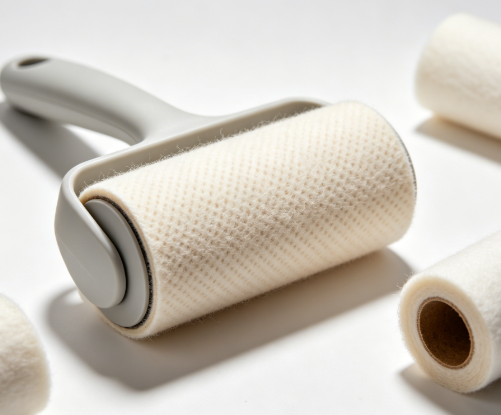
Choosing a reliable hair remover roller manufacturer is not only about product appearance. It is about long-term supply stability, consistent performance, and predictable quality across batches. In a market with many options, careful evaluation becomes part of the sourcing process.
What defines a reliable Hair Remover Roller Manufacturer ?
A reliable manufacturer is usually consistent rather than flashy. The focus is on repeatable output and stable production behavior.
In practice, reliability is reflected in how closely each batch matches the previous one. It is also shown in how the product performs under different usage conditions, such as fabric type or cleaning frequency.
Manufacturers with stable systems tend to pay attention to small details that affect daily use. These include adhesive balance, surface smoothness, and rolling comfort.
Why does production consistency matter so much?
Consistency is often the first indicator of manufacturing reliability. Hair remover rollers may look simple, but even slight variation can affect performance.
If adhesive strength changes from batch to batch, the user experience becomes unpredictable. If the roller surface is uneven, cleaning efficiency drops.
Consistent production helps ensure that every unit behaves in a similar way. This is especially important for distributors and retailers who expect uniform product quality over time.
What materials are commonly used in production?
Material selection influences both durability and user experience. A hair remover roller typically combines several components, each with a specific role.
| Component Area | Common Material Type | Function in Use |
|---|---|---|
| Roller surface | Adhesive film layer | Collects lint and hair |
| Handle body | Plastic-based frame | Provides grip and structure |
| Core structure | Reinforced support | Maintains shape stability |
| Protective cover | Lightweight material | Keeps roller clean during storage |
Each part contributes to the overall performance. When materials are well matched, the roller feels smooth in operation and remains stable during repeated use.
How does manufacturing process affect product quality?
The way a product is made often influences how it behaves in real use. Even small differences in assembly can affect rolling smoothness or adhesive distribution.
A stable manufacturing process usually focuses on controlled assembly steps and careful material handling. This reduces variation and helps maintain predictable output.
Attention to process detail also helps reduce common issues such as uneven adhesion or structural looseness during use.
What role does product design play in usability?
Design is not only about appearance. It directly affects how the roller is held, rolled, and replaced.
A comfortable handle shape can reduce strain during repeated use. A well-balanced structure helps the roller move smoothly across surfaces. Even the angle of contact can influence how effectively debris is collected.
Design also affects storage and portability. Compact and practical structures are often preferred in daily cleaning environments.
How can you evaluate manufacturer quality before cooperation?
Before choosing a supplier, many buyers look at several practical indicators. These are not complex metrics, but simple observations that reflect production capability.
Common evaluation points include:
- Stability of sample products across batches
- Surface finish and structural alignment
- Responsiveness during communication
- Ability to support design adjustments
- Clarity in production and delivery workflow
These factors help form an initial understanding of whether a manufacturer can maintain consistent output over time.
What challenges appear in hair remover roller production?
Even in mature production environments, challenges still exist. These challenges are often related to balance and repeatability.
Some common issues include:
- Uneven adhesive distribution across surfaces
- Small differences in rolling resistance
- Wear variation during long-term use
- Material compatibility between components
- Handling sensitivity during packaging
These issues may not always be visible at first glance. They tend to appear during repeated use or large-scale production runs.
How does customization influence manufacturer selection?
Customization has become an important consideration in many sourcing decisions. Different markets may require different handle shapes, surface strengths, or packaging styles.
A manufacturer that supports flexible adjustment can better match these needs. Customization does not only refer to appearance changes. It also includes structural adaptation and material combination.
This flexibility often reflects how adaptable a manufacturer is in real production environments.
What does quality control look like in practice?
Quality control is usually a continuous process rather than a single step. It involves checking consistency during and after production.
This may include surface inspection, structural alignment checks, and usability testing under repeated movement.
The goal is to identify variation early. When issues are detected at an early stage, adjustments can be made before large batches are affected.
How does supply stability affect long-term cooperation?
For many buyers, supply stability is as important as product quality. A reliable manufacturer is able to maintain steady production over time without frequent interruptions.
This stability supports planning, inventory control, and distribution scheduling. It also reduces uncertainty in downstream operations.
When supply is consistent, businesses can focus more on market demand rather than production fluctuations.
What role does communication play in manufacturer selection?
Communication often reflects how a manufacturer manages cooperation. Clear responses, structured explanations, and timely updates help build trust in the working relationship.
It is not only about speed. It is also about clarity and consistency in information sharing.
Good communication helps reduce misunderstandings and supports smoother coordination during production and delivery stages.
How do manufacturers support long-term product performance?
Long-term performance depends on both design and production discipline. A stable manufacturer pays attention to small details that influence repeated use.
These include material balance, structural durability, and consistent assembly practices. Over time, these elements help maintain product reliability in different environments.
In many cases, long-term performance reflects not only the product itself but also the manufacturing approach behind it.